
LPO Events Calendar
Latest LPO Events
Who Represents Me?

Please enter in your Zip+4 code to see who your current representitives are and any candidates who have filed or enter a candidate or official's last name to see their information.

Home
Banner

THE COLUMBUS DISPATCH

The party that advocates the small -- small taxes, small government, small infringements on personal freedom -- is trying to grow up and play with the big boys.

Seemingly better organized, and riding a wave of anti-government sentiment fueled by a poor economy, rising deficits and a national Tea Party movement, Libertarians want to harness the public's dissatisfaction with the two major parties to become a true force in Ohio politics.

Libertarians are running in every nonjudicial statewide race and have filed in a number of congressional and state legislative races where, even if their chances of victory are remote, some think they could play a role in close outcomes that could help determine which party controls both Congress and the Ohio House.

"The discontent with the two parties has stirred a lot of interest in people who want to get involved and are seeking an alternative," said Charlie Earl, the Ohio Libertarian Party's communication director and a candidate for secretary of state.

A state representative in the early 1980s, Earl said he was a Republican for 42 years.

"Even when Republicans have been in power, government has grown larger," he said. "We are sprinting toward tyranny and socialism with the Democrats. With Republicans, we merely jog there."

Earl said the Libertarian Party made more of an effort to recruit candidates this year.

Paul Beck, an Ohio State University political-science professor, said the popularity of third parties ebbs and flows.

"It's probably at its height when there is a good deal of distrust of incumbents and negative feelings toward the two major parties," he said.

Though it's still unlikely to translate into victories, Beck said, Libertarians can have an impact on state races.

"Right now, the momentum is with the Republicans because they are the out party," he said. "If third-party candidates can divide the oppositional sentiment, (Democrats) can eke out some victories."

House Minority Leader William G. Batchelder, R-Medina, is trying to net a four-seat pickup in November to regain control of the Ohio House. He said Libertarian candidates could pose a problem, especially in tight races.

For example, in 2008, a big year for Democrats in Ohio, Democrat Marian Harris won the 19th Ohio House District in eastern Franklin County by just 735 votes in a race where Libertarian Michael Johnston picked up nearly 3,400 votes. In the 20th district, which covers Gahanna and Bexley, Democrat Nancy Garland won by 1,652 votes.

This year, Johnston is again running in the 19th district, while Libertarian Lawrence Binsky has entered the 20th.

"Obviously they aren't going to win," Batchelder said of the Libertarians.

"If they take enough votes away from the Republicans, they may be able to keep taxes high by their efforts. Defeating a Republican who is committed to conservative principles does not help conservatism if they end up with a majority of people who have shown they are not as concerned with tax increases and government intervention."

In 2008, some observers said Libertarian Mark Noble helped Democrat Mary Jo Kilroy edge out Republican Steve Stivers in central Ohio's 15th Congressional District.

Noble, the Franklin County Libertarian chairman, is now running in the 22nd Ohio House District. Asked about Batchelder's comment, he said, "That is the kind of attitude taken by people who feel they own votes. When voters vote for minor party candidates, they are able to voice their discontent."

The split between Libertarians and Republicans was highlighted this week when, with the Conservative Political Action Committee holding its annual conference, Libertarian Party Executive Director Wes Benedict ripped the group as a bunch of phonies.

"Unlike libertarians, most conservatives simply don't want small government. They want their own version of big government," he said, pointing to foreign wars, bank bailouts and farm subsidies.

Though Noble and other Libertarians say they draw votes from both parties, House Democrats are happy to see the third-party candidates.

"Because Libertarians are often pulling from a conservative base, I think it will help our Democrats shore up a larger vote total," said Liz Brown, political director for the Ohio House Democratic Caucus.

Still unknown is how the Tea Party movement will affect Ohio elections. Libertarian philosophies generally mesh well with tea partiers.

"We share a lot of the same values, but they are very wary of us, as we are of them," Earl said. "Some of them grab us and endorse us and hug us and love us."

But some Tea Party factions, Earl said, want to restore the Republican Party. "We feel that party has failed."

jsiegel@dispatch.com


Written by Jillian Mack - Libertarian Party Candidate for Ohio House District 33

Convincing Voters…and Candidates

Frequently I hear from Republicans who say that the Libertarian Party is just taking votes from the Republican Party, or a vote for a Libertarian candidate is a vote that was “thrown away.”  Even though many of these folks more closely align with the libertarian philosophy, at the present time they will almost never vote for a Libertarian Party candidate for fear of taking a vote away from the Republicans, and allowing a Democrat to win the seat.

After encountering this thinking pattern so many times in my discussions with everyday voters, I’ve begun to think of ways to help them see the issue from a different perspective, in the hopes of getting them to vote for a Libertarian Party candidate someday.

  • If rather than voting your conscience you vote for candidate just because they have the letter next to their name which you feel is the lesser of two evils, isn’t that really a vote that was thrown away?
  • You keep voting Republican and then repeatedly find yourself unhappy with your elected Republican officials.  Wasn’t it Albert Einstein who said that the very definition of insanity is doing the same thing over and over and expecting a different outcome?

Although I stand by these arguments and will continue to assert them to potential LP voters, I’ve also begun to think that it may not be just the voters who need to be convinced of something.  That perhaps it’s the Libertarian Party and our candidates who need to be convinced of something.

If we, as a party, always target the Republican voters under the false pretense that Democratic voters do not tend to be libertarian-minded, I think we will always be doomed to fail, because we’ll always be perceived by Republicans as the party who will let the Democrats win by taking Republican votes.

Until recently, I had never talked politics with a long-time co-worker and friend of mine, because I usually try to keep political debates away from the workplace.  However, I recently asked him for his signature on my petition to run for Ohio House of Representatives, District 33, and this of course opened the lines of political communication.

I had made some assumptions about his voting pattern because he’s a young professional, trying to build his career and save for the future, and he’s married to a bright young woman who is finishing up her residency at a local hospital.  Based on this assessment, I had quite incorrectly predicted that he normally voted Republican.

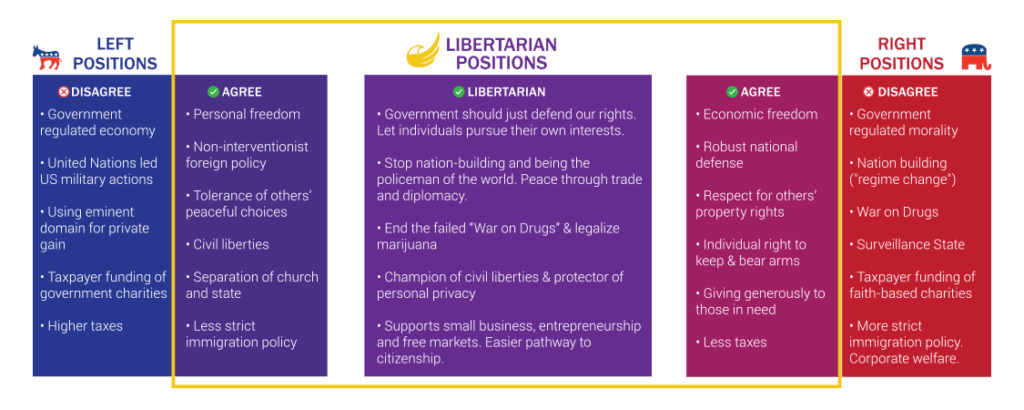
Through our conversation I immediately came to know that he strongly identifies with the libertarian philosophy, but that he always votes Democratic because he can’t let the Republicans win.  When I asked why he felt so strongly, I learned that he has an extreme distaste for the neoconservative position of allowing religion, through the government, to dictate which personal liberties an individual should be afforded.

He is a moral person, an upstanding member of the community, and yet completely non-religious and doesn’t want to be dictated to by those on the “religious right.”  When I asked him how he felt about President Obama’s economic policies, he strongly disagreed with them, but he even more vehemently stated that he’d rather pay $10,000 more per year in taxes than to have the government restrict his personal liberties on the basis of religious beliefs which are held by those in power.

I have a few other close friends who feel this way too, but hearing it come from someone new, and hearing how fervently he expressed these feelings, made me consider how many more voters may feel this very same way.  This led me to consider that the LP may be able to draw in more voters from both sides of the aisle if we target Democratic voters.

It seems to me that the LP did traditionally take voters from the Republicans, as many members of the LP leadership belong to older generations who defected from the Republican Party.  However, we have a younger generation of libertarian-minded people who traditionally have voted or will be easily persuaded to vote Democratic due to the social and personal freedoms they hold so dear.

Over the past 10 years, I can attest to the fact that the LP has gained some popularity and recognition with younger voters, including myself, who have traditionally thought of themselves as Democrats.  Unfortunately, this shift does not seem to be widely known, and has therefore not changed the general perception that we only take votes from Republicans.

If we actively target and capture this group of youthful voters by presenting them with the true principles of freedom which the LP has to offer, perhaps we can both build our voter rolls with former and potential Democrats and simultaneously change the perception that we only take votes from Republicans.  In turn, I think this change in perception of where we get our votes could make it more likely that we could win those libertarian-minded voters who have traditionally voted Republican, because we’d be perceived as taking votes equally from both major parties.

The next topic to consider: how do we properly target traditionally or potentially Democratic voters?

Last Updated (Friday, 05 March 2010 11:51)

 
LPO Polls
What has been Gov Stricklands biggest failure?
 
LPO Announcements

Sign up to receive important
LPO Statewide Announcements (SWA)!
Fill out the required information and subscribe.
To submit a news item, or if you are in the media,
please send to news@lpo.org.  

To post or update an event,
or contact the LPO about an event,
please send an email to: calendar@lpo.org.

To submit a question for the LPO web poll,
please send the question to: webpoll@lpo.org.  

For information, please send an email to: info@lpo.org


The World's Smallest Political Quiz!
Find Us Online

myspace    MySpace 
facebook    Facebook 
twitter logo    Twitter 
meetup Meetup
youtube YouTube
The Libertarian Party of Ohio
The Libertarian Party of Ohio (LPO) is the only political party in Ohio dedicated to the principles of smaller, limited government, lower taxes and more personal liberty for the residents of the State of Ohio. Neither the Democrats nor the Republicans can make this claim. The Libertarian Party of Ohio (LPO) is the third largest political party in the state. Whether the issue is school choice, economic stimulus, gun rights, or property rights, the LPO will always favor the principles of limited government and maximum personal liberty. The Libertarian Party of Ohio has the same vision as the Libertarian Party, which is "for a world in which all individuals can freely exercise the natural right of sole dominion over their own lives, liberty and property by building a political party that elects Libertarians to public office, and moving public policy in a libertarian direction."